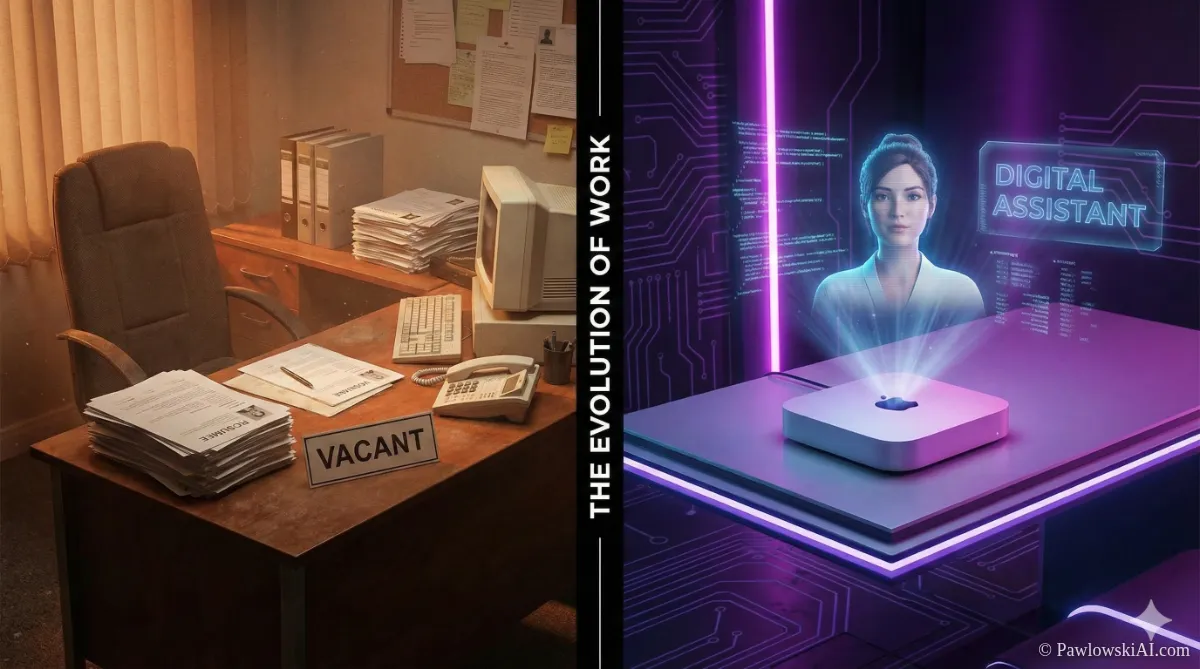
Remember the old days? You know, way back in 2023? Back then, if you wanted to build an app, you had to actually know how to code. You spent hours hunting for missing semicolons, debugging obscure error messages, and crying over Stack Overflow threads that were closed as “duplicates” six years ago.
Well, grab your coffee and sit down, because the game has changed. Welcome to the era of vibe coding.
If you’ve been scrolling through X (formerly Twitter) or hanging out in developer Discords lately, you’ve probably seen the term tossed around. Maybe you saw Andrej Karpathy tweeting about it. Maybe you saw a teenager build a SaaS unicorn in a weekend. Or maybe you’re just wondering why everyone is suddenly “vibing” with their IDEs.
In this massive deep dive, we’re going to break down exactly what vibe coding is, why it’s taking over the software world in 2026, and—most importantly—how you can use it to build cool stuff without losing your mind.
Let’s get into the vibes.
What is Vibe Coding?
Let’s start with the definition. Vibe coding is a software development philosophy where the human developer focuses entirely on the outcome (the vibe) rather than the implementation (the code).
Instead of writing syntax line-by-line, a vibe coder uses natural language to describe what they want to an advanced AI agent (like Cursor’s Composer, Replit Agent, Claude Code, or Windsurf). The AI handles the syntax, the libraries, and the boilerplate. The human just manages the “vibes”—guiding the project, spotting errors, and steering the ship.
The term was popularized in early 2025 by AI legend Andrej Karpathy, who described it as a state where you “fully give in to the vibes, embrace exponentials, and forget that the code even exists.”
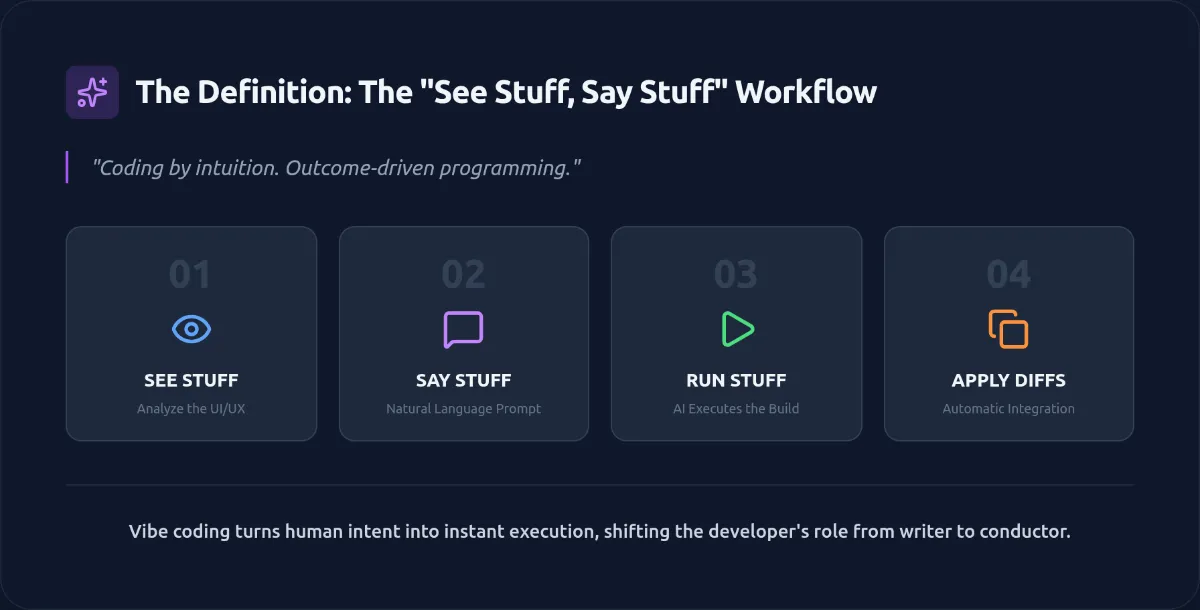
The “See Stuff, Say Stuff” Method
Karpathy summarized the workflow perfectly:
- See Stuff: You look at the app.
- Say Stuff: You tell the AI, “Make that button blue and bounce when I click it.”
- Run Stuff: The AI writes the code, and you run it.
- Copy-Paste Stuff: (Or in 2026, just let the agent apply the diffs automatically).
It is coding by intuition. It is “outcome-driven programming.” It is the democratization of software creation on a scale we haven’t seen since the invention of the graphical user interface.
But here is the kicker: Vibe coding isn’t just for non-coders. Senior engineers are using it to speed up their workflow by 10x. Why write a regex function from scratch when you can just vibe it into existence in three seconds?
Why is Vibe Coding Trending Now?
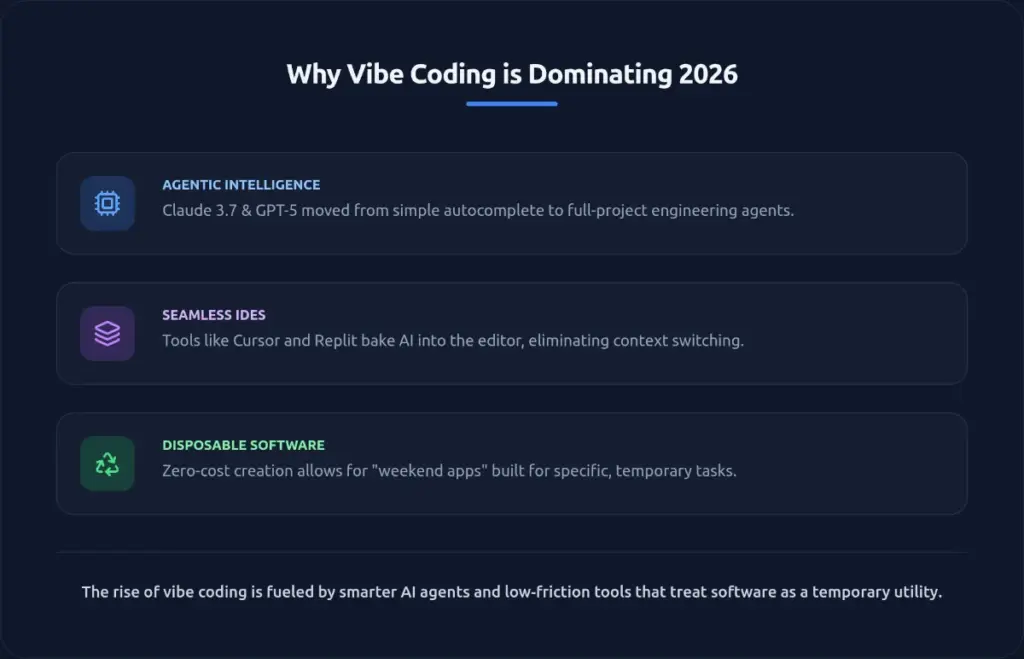
You might be thinking, “Wait, haven’t we had GitHub Copilot for years?” Yes, but 2025 and 2026 marked a massive shift. We moved from Autocomplete (AI finishing your sentence) to Agentic Coding (AI finishing your project).
1. The Models Got Too Good
With the release of models like Claude 3.7 Sonnet and GPT-5, LLMs stopped being just “smart autocomplete” and started acting like mid-level engineers. They can understand context across thousands of files. They can plan architecture. They can debug their own mistakes.
2. The Tools Evolved
Tools like Cursor, Claude Code, and Replit changed the interface. You aren’t pasting code from ChatGPT into VS Code anymore. The AI lives inside your editor or terminal. It can see your file structure, run your terminal, and fix bugs before you even realize they exist. This seamlessness is what allows the “vibe” state to happen—you aren’t context-switching; you’re just flowing.
3. The “Throwaway” Culture
In the past, building an app was an investment. You had to plan it, build it, maintain it. Vibe coding allows for “disposable software.” Want a custom dashboard just to track your fantasy football league this weekend? Vibe it on Saturday morning, use it on Sunday, delete it on Monday. The cost of creation has dropped to near zero.
Pro Tip: If you are looking to understand the deeper mechanics of how these models actually “think,” our AI Fundamentals Academy has a great module on Large Language Model architecture. It helps to know why the AI makes certain mistakes so you can vibe-check them better.
How to Vibe Code: A Step-by-Step Workflow
Ready to try it? You don’t need a Computer Science degree (though it helps—we’ll get to that later). You just need an idea and a bit of patience.
Step 1: The “Dream” Prompt
Start with a high-level description. Don’t speak in code; speak in product requirements.
- Bad Prompt: “Create a React component with a useState hook…”
- Vibe Prompt: “I want a landing page for a dog walking service called ‘Paws & Reflect.’ It should feel cozy, use earth tones, and have a big hero section with a signup form.”
Step 2: Let the Agent Cook
Hit enter. Watch the tool (let’s say, Cursor Composer) spin up the file structure. It will install Tailwind CSS, set up the routing, and generate the copy. This is the magic moment where you “forget the code exists.”
Step 3: The Vibe Check (Iteration)
This is where the real work happens. You look at the result. Maybe the button is ugly. Maybe the form doesn’t actually submit.
- You say: “The vibe is a bit too corporate. Make the font more playful and add a Framer Motion confetti animation when I submit the form.”
- The AI: Rewrites the CSS and adds a JavaScript animation library.
Step 4: Debugging by Complaint
In traditional coding, debugging involves reading stack traces. In vibe coding, debugging involves complaining to the AI.
- You: “I clicked the button and nothing happened. Fix it.”
- The AI: “Apologies. I forgot to bind the click handler. Fixing it now.”
Step 5: Ship It
Tools like Replit or Vercel now allow for one-click deployment. You go from “I have an idea” to “Here is the URL” in under an hour.
The Tools of the Trade (2026 Edition)
If you want to be a vibe coder, you need the right rig. Here is what the pros are using:
1. Cursor (The King of Vibes)
Cursor is a fork of VS Code that has AI baked into its DNA. Its “Composer” feature allows you to edit multiple files simultaneously with natural language. It is currently the gold standard for vibe coding.
2. Claude Code (The Terminal Agent)
For those who prefer living in the terminal, Claude Code is the ultimate tool. It is an agentic CLI directly from Anthropic that manages your environment, runs commands, handles git commits, and authenticates for you. It feels less like an editor plugin and more like a senior engineer sitting inside your command line.
3. Replit Agent
Replit is perfect for beginners or pure “web” vibes. Their Agent can plan a project, install dependencies, and deploy it, all while you watch on your phone. It feels less like coding and more like managing a contractor.
4. Windsurf
A newer entrant from Codeium that focuses on “deep context.” It remembers things you said three hours ago, which is helpful when your vibes start getting complicated.
The Dark Side: When the Vibes Are Off
Okay, let’s get real for a second. It’s not all sunshine and confetti animations. Vibe coding has some serious risks, and if you aren’t careful, you’ll build a digital house of cards.
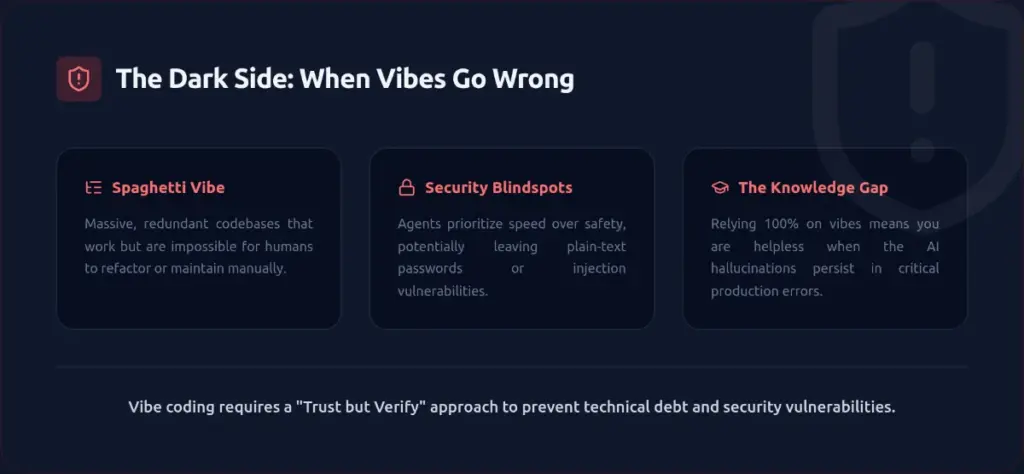
1. The “Spaghetti Vibe”
AI is great at writing code, but it’s terrible at cleaning code. If you keep asking for features without refactoring, you will end up with a codebase that is massive, redundant, and impossible to maintain. We call this “Spaghetti Vibe.” It works, but don’t look under the hood.
2. Security Nightmares
If you tell an AI to “make a login form,” it might do it securely, or it might store passwords in plain text because that was the easiest solution it found in its training data. Vibe coding requires a “trust but verify” mindset. You should always cross-reference with OWASP Top 10 guidelines.
- Warning: Never vibe code with real customer data unless you have audited the code.
3. The “It Works Until It Doesn’t” Problem
You might build a working app in an hour. But when it breaks a week later, do you know how to fix it? If you don’t understand the code the AI wrote, you are helpless. You are stuck waiting for the AI to fix itself, which doesn’t always work.
Soft Sell Alert: This is exactly why we tell our students: AI is a multiplier, not a replacement. You need to understand the basics of security and architecture to effectively manage the AI. If you want to move from “hobbyist vibe coder” to “professional AI architect,” check out our Full-Stack AI Engineering Roadmap. We teach you how to spot the security holes the AI misses.
Is Traditional Coding Dead?
Short answer: No.
Long answer: It’s changing.
We are moving toward a “Sandwich Model” of development:
- Top Bun (Human): Vision, architecture, and “vibes.”
- Meat (AI): Syntax, boilerplate, and implementation.
- Bottom Bun (Human): Verification, security audit, and deployment.
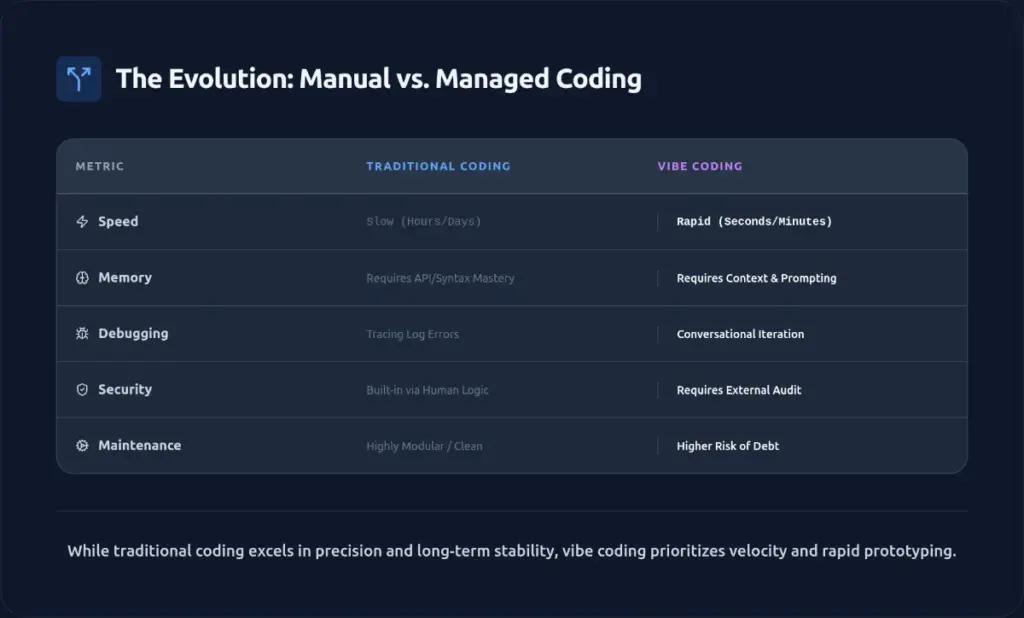
Pure syntax coding—typing public static void main—is dying. But engineering is more alive than ever. The ability to structure a system, manage data flow, and ensure security is still a uniquely human skill. Vibe coding just removes the tedious typing part.
What’s Next for Vibe Coding?
We are just in the early innings. By late 2026, we expect vibe coding tools to start handling:
- Full Infrastructure: “Spin up a scalable AWS architecture for this app.”
- Voice Vibes: literally talking to your IDE while you walk around the room.
- Self-Healing Code: Apps that detect their own bugs in production and patch themselves.
The gap between “I have an idea” and “I have a product” is shrinking every day. The question isn’t whether you should start vibe coding—it’s whether you can afford not to.
So, go ahead. Open up Cursor. Describe your dream app. And give in to the vibes.
Want to stay ahead of the AI curve? We drop new articles on vibe coding and AI architecture every week. Bookmark our blog and sign up for the newsletter so you never miss a vibe check.