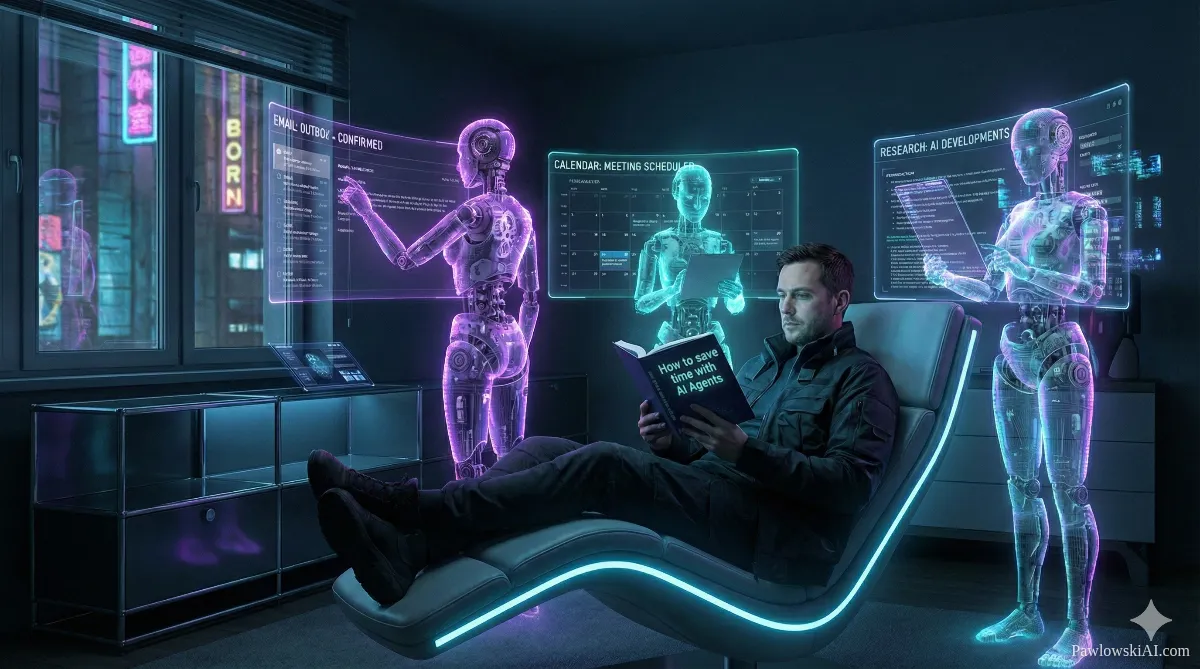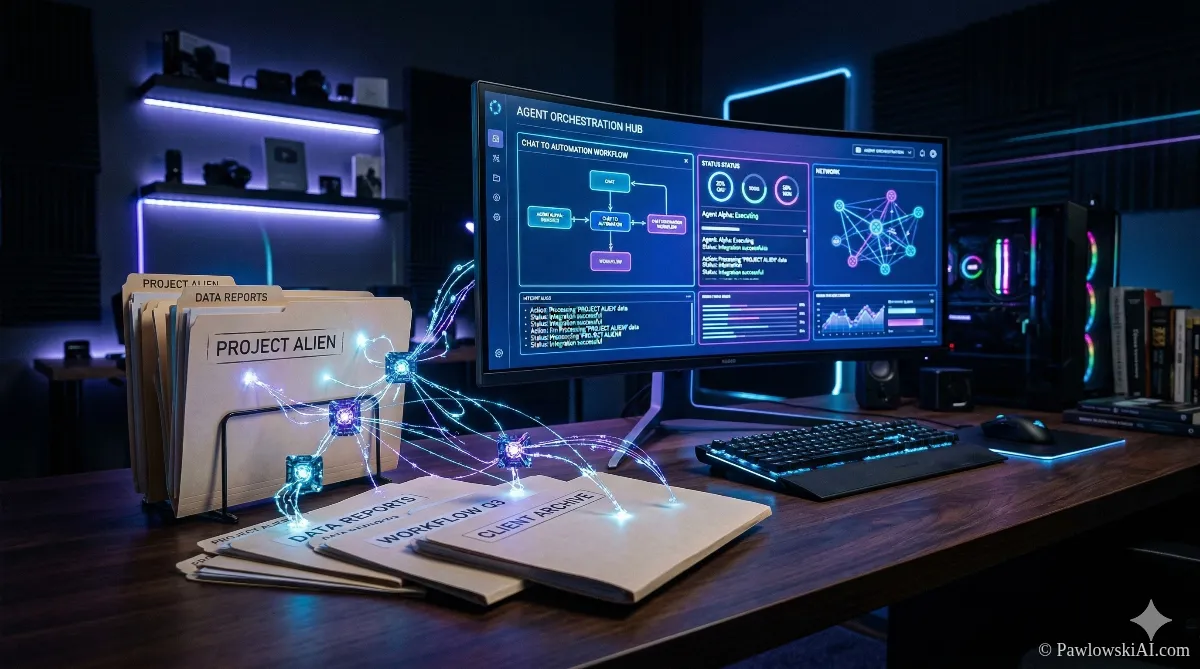
Let’s be brutally honest: how many times today have you copied text from a PDF, pasted it into an AI chat window, and then manually copied the result back into your local drive? If you're like most professionals, the answer is "too many."
In this Claude Cowork Beginner's Guide, we tackle the exhausting "tool fatigue" plaguing every highly digitized knowledge worker. For years, we've treated artificial intelligence like a highly intelligent but ultimately lazy intern. We've been stuck in an endless, manual copy-paste loop between local documents and web chats that feels less like the future of work and more like a high-tech game of ping-pong.
But that era is officially over. Anthropic's new desktop application changes everything by bringing the AI directly to where your data actually lives. In this comprehensive walkthrough, we'll explore the underlying architecture, the real-world enterprise economics, and the practical, step-by-step instructions to transition from passive chatbots to autonomous digital coworkers. You are going to learn how to reclaim hours of your time—and you won't need to write a single line of Python to do it. Let's get to work.
The Paradigm Shift: From Chatbots to Agentic AI Automation
To understand why Cowork is a big deal, we need to draw a hard line between generative AI and agentic AI.
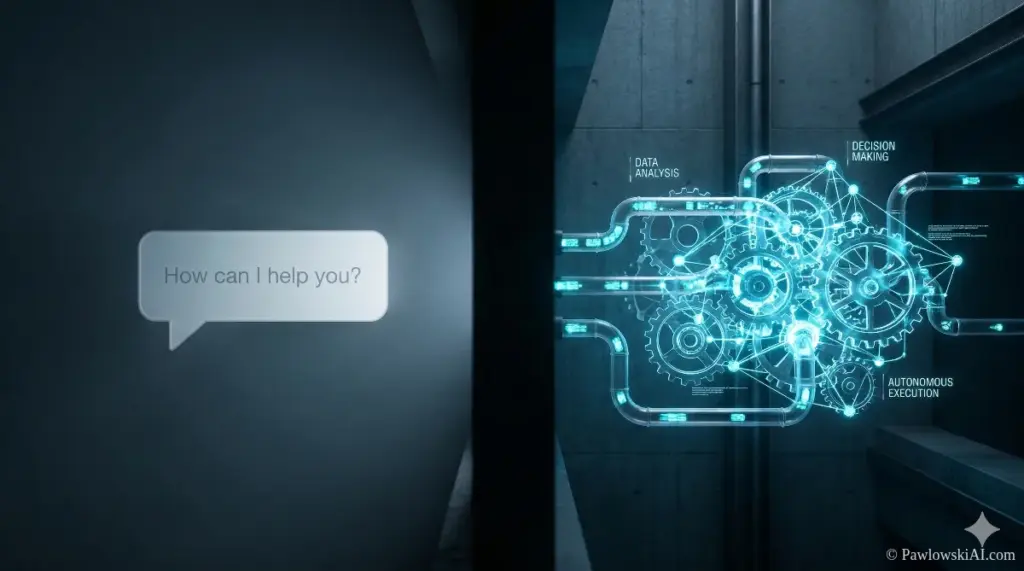
Generative AI (think standard ChatGPT or the web version of Claude) is stateless. It waits for your prompt, generates an answer, and goes back to sleep. Agentic AI automation, on the other hand, implies agency. It means giving the system a goal, a set of tools, and the permission to execute a multi-step workflow across your local files without you holding its hand.
The macroeconomic impact of this shift is staggering. According to comprehensive analysis by McKinsey & Company, AI is no longer just a peripheral experiment for quirky marketing copy; it is a core operational requirement. Capital is shifting rapidly away from just training foundational models toward applied, revenue-generating workflows.
Need hard numbers? Gartner predicts that a massive 40% of all enterprise software applications will feature embedded, task-specific AI agents by the end of 2026. To put that in perspective, that number was sitting at less than 5% in 2025.
We aren't just adopting new software; we are adopting a new workforce paradigm.
What Actually is Claude Cowork?
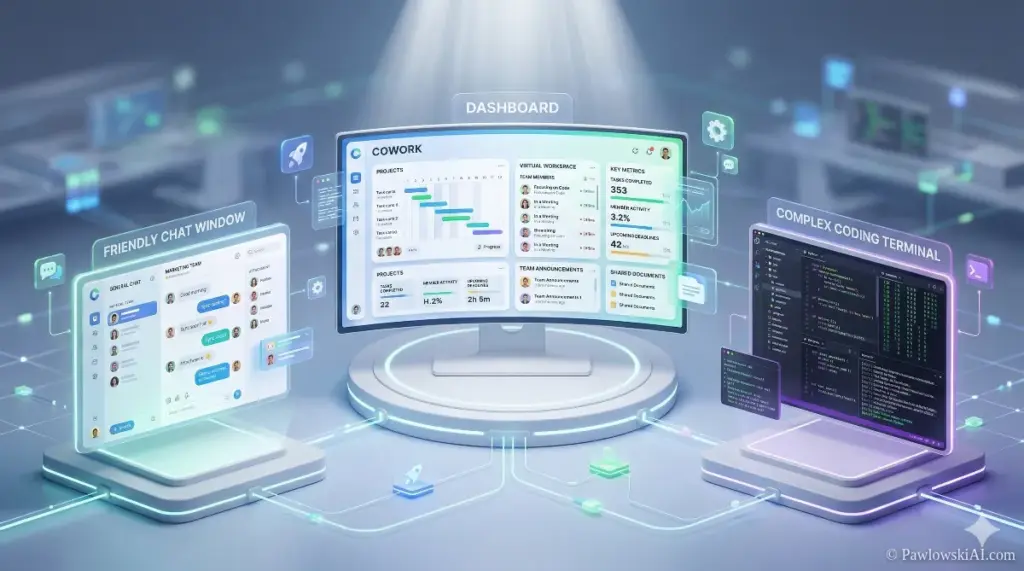
Before we get to the setup, let's clarify the Anthropic product ecosystem, because it can get confusing faster than a nested spreadsheet.
- Claude Chat (Web): The standard interface. Great for brainstorming, terrible for local file manipulation.
- Claude Code: A powerful, command-line interface (CLI) tool built strictly for software engineers. If you don't dream in terminal commands, this isn't for you.
- Claude Cowork: The sweet spot. It wraps profound autonomous capabilities within a visually accessible desktop application. It requires zero programming.
Cowork is designed to sit on your desktop, look at the local directories you point it toward, and autonomously restructure, analyze, or generate unstructured data seamlessly.
Avoiding the Klarna Paradigm
Before you fire your entire staff, a word of caution. We call this the "Klarna Paradigm." The Swedish fintech giant Klarna famously replaced 700 human customer service agents with AI, only to see their customer service quality take a noticeable hit.
Cowork’s underlying philosophy is entirely different. It is built on the belief that AI must act as an autonomous tool directed by human expertise, not an unsupervised replacement for human judgment. You are the director; Cowork is the crew.
The Architecture: Why the Apple VZVirtualMachine Keeps You Safe
Giving an AI read-and-write access to your local hard drive sounds absolutely terrifying, right? What if it hallucinates and decides to delete your entire Documents folder because it thought it was "optimizing your storage"?
Anthropic solved this elegantly. When you initiate a command, it does not execute directly upon your host operating system.
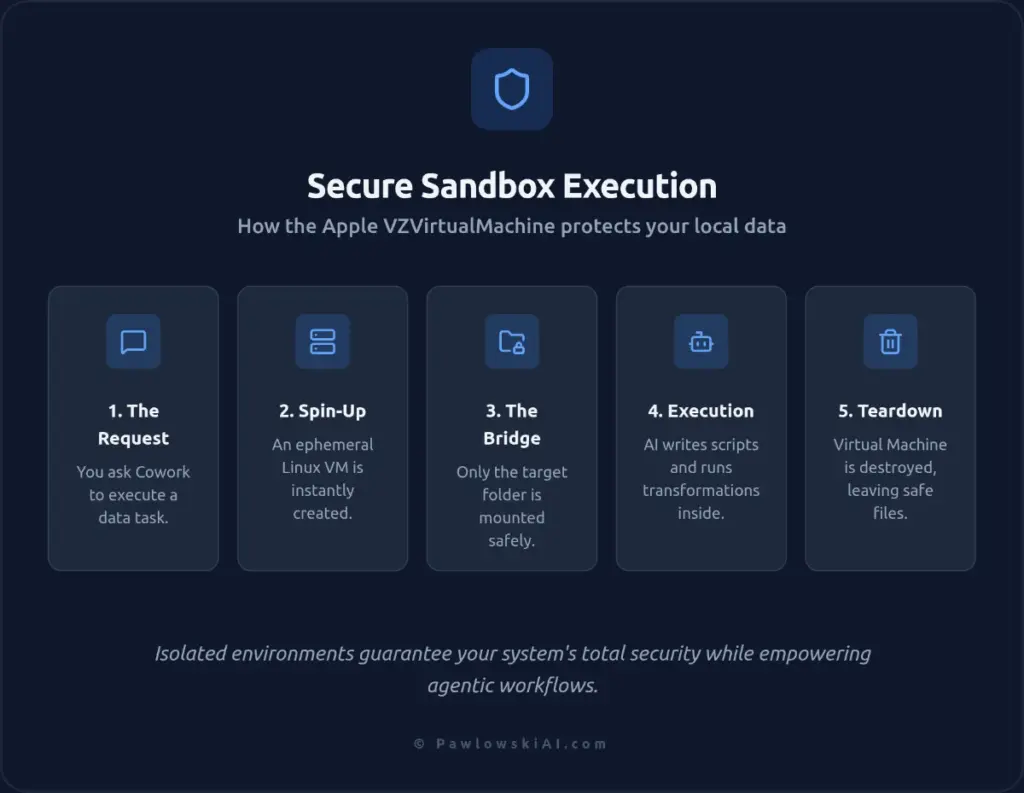
Instead, Cowork relies on strict sandboxing technology, heavily utilizing frameworks like the Apple VZVirtualMachine on Mac. When you ask Cowork to execute a task, it spins up a highly constrained, lightweight Linux virtual machine in the background.
How the Sandbox Operates (Step-by-Step)
- The Request: You ask Cowork to reformat 50 CSV files in a specific folder.
- The Spin-Up: Cowork creates an ephemeral, isolated Linux VM.
- The Bridge: It temporarily mounts only the specific folder you granted it access to into that VM.
- The Execution: The AI writes its Python scripts and runs the data transformations inside the virtual machine.
- The Teardown: Once the files are updated, the VM is instantly destroyed.
This strict sandbox provides an ironclad security boundary. Should the AI hallucinate a destructive script, the operational fallout is entirely contained within the disposable VM, protecting your primary drive and your sanity.
Mastering the Model Context Protocol (MCP) in This Claude Cowork Beginner's Guide
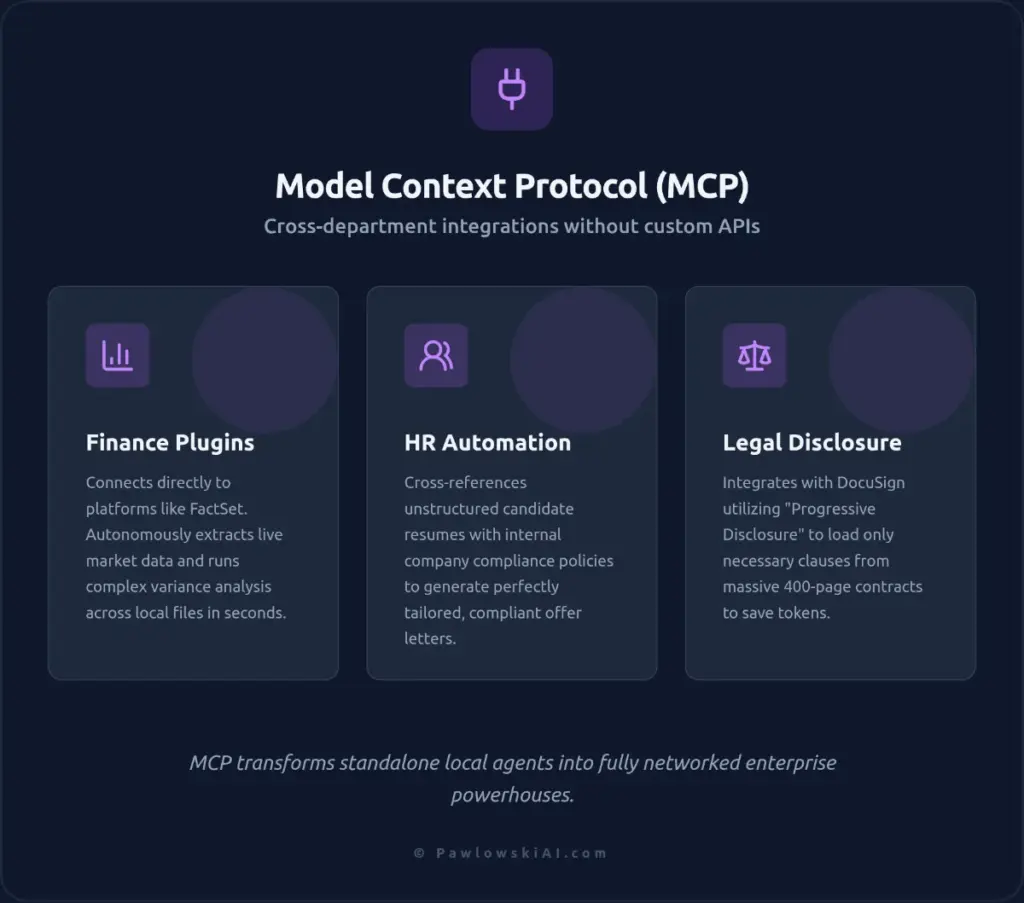
If you want to move from a beginner to a power user, you need to understand the Model Context Protocol (MCP). Think of MCP as the universal translator that allows Cowork to talk directly to your other enterprise tools without you having to build custom APIs.
Here is how MCP is changing the game across different departments:
Finance Plugins
Imagine connecting Cowork directly to platforms like FactSet via an MCP integration. Instead of downloading data, cleaning it in Excel, and running a macro, the agent autonomously extracts real-time market data. It then runs complex variance analysis across your local CSV files instantly, dropping a formatted executive summary on your desktop.
Human Resources Automation
HR departments are bogged down by compliance. With MCP, you can point Cowork at an inbound folder of unstructured candidate resumes and your company's massive internal policy documents. The agent can autonomously cross-reference the candidate's requested terms against company policy to draft highly compliant, personalized offer letters in seconds.
Legal and Progressive Disclosure
Legal documents are massive token-hogs. Pushing a 400-page master service agreement into an AI usually crashes the context window. Cowork utilizes MCP with tools like DocuSign using a technique called "Progressive Disclosure." It loads heavy legal instructional payloads only when the specific context demands it, preserving token efficiency and keeping the AI laser-focused on the specific clause you need amended.
Step-by-Step: Your First Claude Desktop Agent Setup
Let’s get our hands dirty. The beauty of the Claude desktop agent setup is its simplicity. If you can install a web browser, you can install your new digital coworker.
Step 1: The Installation and Permissions
Download the application from Anthropic's official portal. Upon the first launch, you will be met with a permissions screen. Do not skip this. Cowork needs explicit folder-level permissions.
- Best Practice: Create a dedicated "Cowork Sandbox" folder on your desktop. Only give the agent permission to read and write to this specific directory to start.
Step 2: The Directory Point
Open the UI and drag-and-drop your target folder into the Cowork interface. You’ll see the agent instantly index the directory. It isn't copying your files to the cloud; it is creating a local semantic map of your data so it knows where everything is.
Step 3: The Natural Language Prompt
Here is where the magic happens. Instead of writing code, you write intent.
- Bad Prompt: "Fix these files."
- Good Prompt: "Analyze the 12 PDF invoices in this folder. Extract the vendor name, date, and total amount. Create a new master CSV file named 'Q3_Expenses.csv' and format the data chronologically."
Hit enter. Watch the UI. You will literally see Cowork planning its steps, writing a temporary script in its secure VM, executing it, and dropping the finished CSV right into your folder.
Need help mastering these exact workflows? Our academy offers a comprehensive roadmap through our "AI Agents Without Programming" course. We walk you through over 50 specific use cases just like this, tailored for non-technical managers.
Real-World ROI: Case Studies from the Enterprise Frontlines
If you are trying to convince your boss (or yourself) to invest the time into this tool, the data is heavily in your favor.
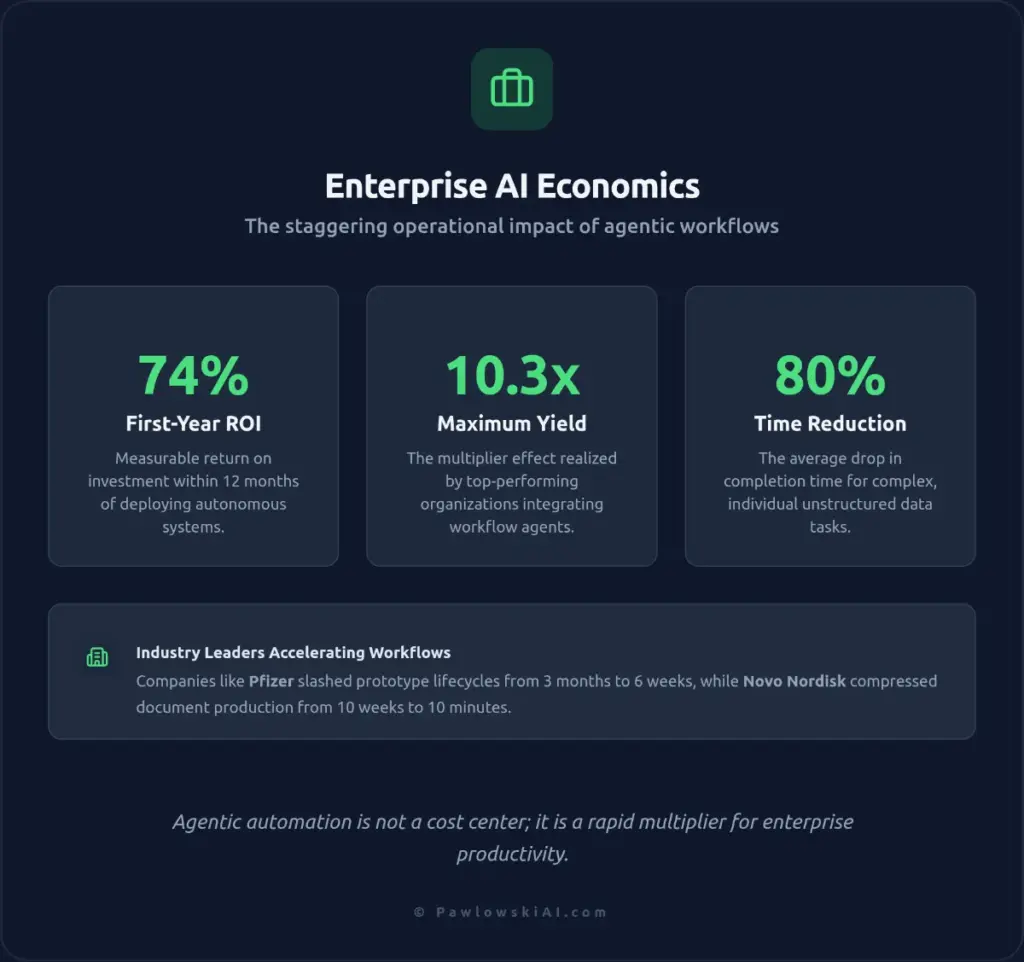
Enterprise executives report achieving a staggering 74% measurable return on investment within the first 12 months of deploying these specific agentic workflows. Even more impressively, top-performing organizations are realizing up to a 10.3-fold return on their initial autonomous systems investments.
Based on large-scale telemetry data, Anthropic researchers indicate that current-generation AI models reduce individual complex task completion times by approximately 80%. When scaled, economic models suggest this orchestration could increase aggregate US labor productivity growth by 1.8% annually over the next decade.
Let's look at how the heavyweights are applying this today:
Pfizer's Rapid Prototyping
Pharmaceutical giant Pfizer integrated AI agents across their internal systems to handle the massive data collation required for drug trials. By allowing agents to autonomously synthesize unstructured research data, they slashed the timeline for taking a prototype to MVP from over 3 months down to just 6 weeks.
Bridgewater's Alpha Advantage
The world's largest hedge fund, Bridgewater, deployed an Analyst Assistant within a secure Virtual Private Cloud (VPC). Instead of junior analysts spending days hunting for data anomalies, the agentic system reduced the time-to-insight for complex reporting by an astonishing 50% to 70%.
Novo Nordisk's NovoScribe
Novo Nordisk built a custom agent workflow dubbed "NovoScribe" specifically to ingest sprawling clinical trial data. By automating the formatting and compliance checking, they reduced document production lifecycles from 10 agonizing weeks down to a mere 10 minutes.
The Cybernetic Roots: Why Cowork Feels So "Human"
To truly appreciate what you are holding in your hands, we have to look back to 1948. The mechanics of Cowork are not actually new; they are the realization of a 75-year-old dream.
Norbert Wiener, a mathematician at MIT, theorized a concept called "Cybernetics." He proposed that biological and mechanical systems both operate on continuous feedback loops for control. You perform an action, you observe the result, you correct your next action based on that observation.
When you watch Claude Cowork run, it is executing Wiener's cybernetic loop flawlessly. If it writes a Python script to sort your Excel files and the script throws an error, Cowork doesn't stop and wait for you to fix it. It reads the error log, writes a correction, and tries again. It is a self-correcting feedback loop.
Furthermore, the modern "token limit" that governs how much data Cowork can read at once stems directly from Claude Shannon (yes, who the AI is named after). Shannon invented Information Theory in 1948, creating the math necessary to quantify abstract human language into actionable, computable bits. Every time Cowork processes a document, it is standing on the shoulders of these mid-century giants.
Human in the Loop: The Ethan Mollick Perspective
As we integrate these systems, our jobs aren't disappearing, but our daily tasks are radically mutating. Wharton Professor and AI researcher Ethan Mollick perfectly summarized this exact moment in technology:
"Three years ago, we were impressed that a machine could write a poem about otters. Less than 1,000 days later, the era of the chatbot is turning into the era of the digital coworker… 'human in the loop' is evolving from 'human who fixes AI mistakes' to 'human who directs AI work.'"
This is the core takeaway of this guide. Your value is no longer tied to how quickly you can manipulate data in a spreadsheet or draft a standard contract. Your value is now tied entirely to your domain expertise and your ability to orchestrate agents to execute that vision. You are no longer the typist; you are the editor-in-chief of your own digital agency.
Next Steps After This Claude Cowork Beginner's Guide
You now have the conceptual framework, the technical understanding of the VZVirtualMachine sandbox, and the step-by-step setup instructions to begin your transition into the agentic era. The copy-and-paste ping-pong match is officially over.
But reading about a digital coworker and actually managing one are two different skill sets. If you are ready to transition from experimenting with AI to actively managing an automated digital workforce, we can help bridge that final gap.
Our customized business automation services and our flagship "AI Masterclass" are designed specifically to help businesses map their messy, human workflows into clean, agentic processes.
Don't let the technology outpace your operations. Keep experimenting, keep pushing the boundaries of your local sandbox, and stay tuned to our blog. Next week, we'll be dropping a massive, open-source library of our top-performing MCP prompts that you can copy directly into your new Cowork setup.
The future of work isn't coming; it's already installed on your desktop.